
High Income Is Not Wealth: Why Asset Allocation Determines Financial Independence
STRATEGY
Yuvraj Singh
2/20/20261 min read

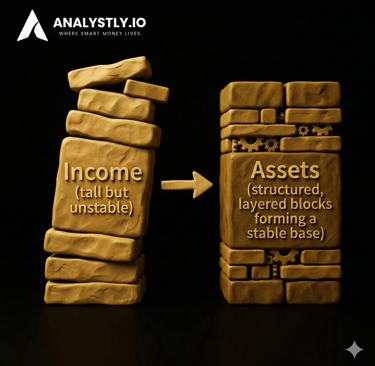
High Income Is Not Wealth: Why Asset Allocation Determines Financial Independence
Rising income creates financial potential.
Only structured allocation converts that potential into wealth.
Many high-earning professionals assume increasing salary automatically builds net worth. In practice, income growth without capital strategy often results in higher expenses, under-invested surplus, and fragmented asset ownership.
The gap between earnings and wealth is structural.
The Lifestyle Expansion Effect
As income increases, so does consumption:
Upgraded housing
Higher discretionary spending
Larger fixed obligations
Delayed investment decisions
Without disciplined allocation rules, surplus capital remains idle or inconsistently deployed.
Income sustains lifestyle.
Assets create independence.
The Allocation Blind Spot
Common patterns in high-income portfolios include:
Excess cash lying unallocated
Random equity exposure without risk calibration
Insurance as investment substitutes
No clear debt–equity–global balance
Wealth is not built by activity. It is built by structure.
Strategic allocation defines:
Risk tolerance
Return expectations
Volatility absorption capacity
Tax optimization
Absent this structure, income growth only amplifies inefficiencies.
Wealth Is a System, Not a Salary
Financial independence emerges when:
Capital generates income
Risk is distributed across assets
Liquidity is planned
Compounding is uninterrupted
At that stage, income becomes optional rather than essential.
The difference between high earners and wealthy individuals is rarely intelligence or opportunity. It is discipline in capital deployment.
Income is an input.
Allocation is the multiplier.
Earning well but unsure whether your capital is structured for long-term independence?
Request a strategic wealth allocation review with Analystly and build a portfolio designed for resilience, compounding and financial autonomy.